Accident on the Tracks

This is the Lokey that went into Rapid River, the first bridge above Camp 9, killing Engineer Frank Snell. Photo #0079
February 26, 1945 was a cold winter day in Camp 9 of the Bloedel Lumber mill in Skykomish. Camp 9 was located about nine miles north of Skykomish. A small crew of seven was all that was present at the camp that morning.
Four of the seven prepared to retrieve some cable with the use of the camp Lokey. By the time they headed up the tracks, at about 10:30 am., the cold winter air was filled with falling snow.
At the throttle was Frank Snell, well-liked by all, and a top “Hogger”. Riding the rear footboards was head brakeman, Mike Bradburn; joining him was second brakeman, Casey Watkins. Inside the cab, with the Engineer, was fireman, Joe Gibson. Joe’s thirty-one year old son, Earl Gibson, along with Hank Walkens and Fred Knutson were left behind at camp when the Lokey headed out for the logging cable.
Unknown to the train crew, high water flowing down Rapid River had undermined the supports of a track bridge about a quarter of a mile out of Camp 9. One of the support logs had become completely dislodged and floated down the river. The bridge looked fine but it wouldn’t hold up under the weight of the seventy ton Climax Locomotive No 11.
The small Lokey was throttled out to about twelve to fifteen miles per hour when they came to the bridge at Rapid River. With no sign of anything amiss, Frank Snell didn’t hesitate in crossing the bridge. Immediately the bridge began listing to the upstream side. The two brakemen bailed off sustaining no injuries. Fireman Joe bailed out through the gangway as the engine was falling into the river. The force of the sudden stop on its side threw engineer Frank Snell against the side of the engine where the open boiler was located. Unable to brace himself, he plunged arms and head into the boiler scalding him terribly.
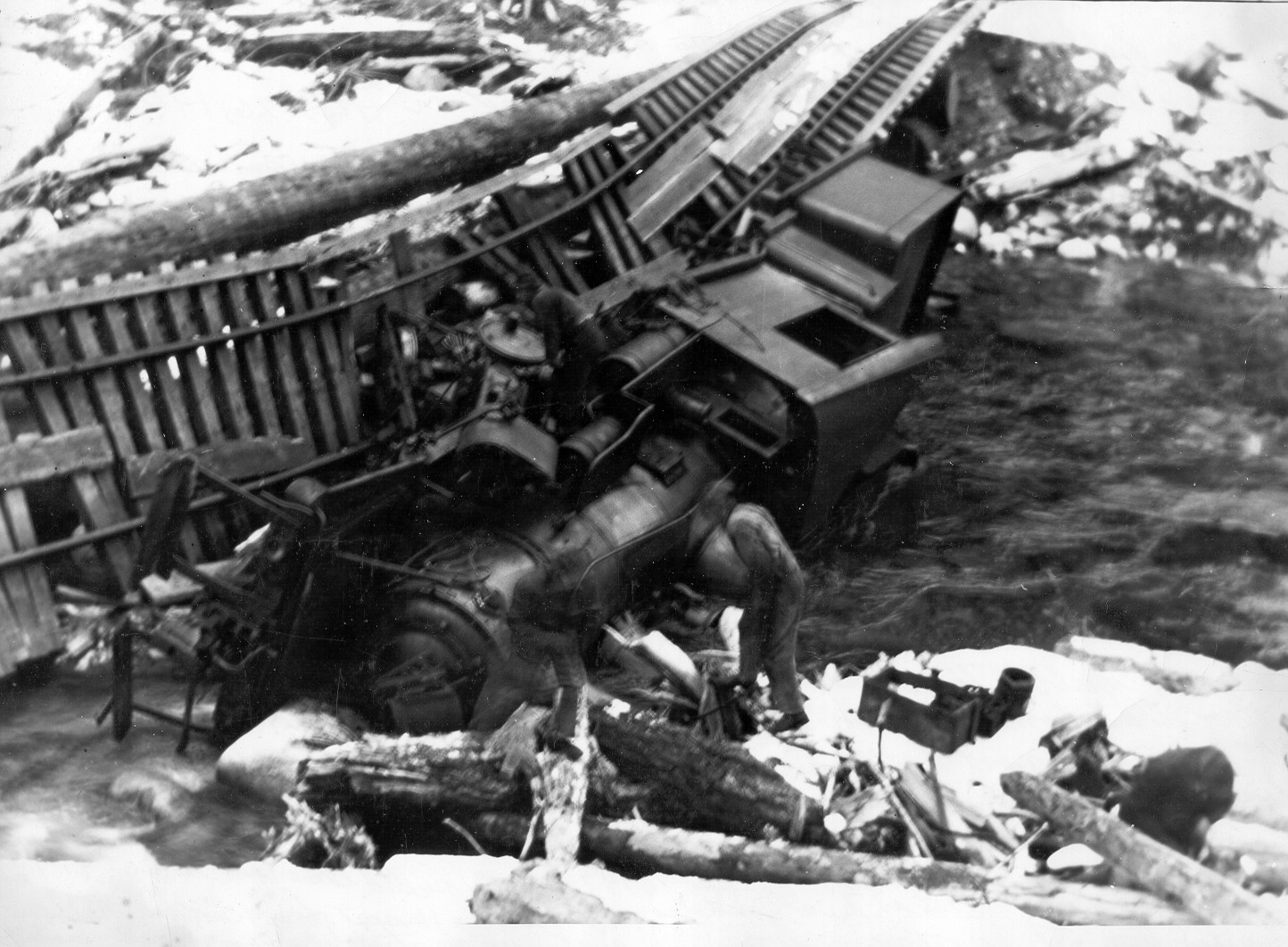
Looking at the Lokey after the accident. #0134
The two brakemen worked feverishly to lift Frank out of the engine cab, after which, head brakeman, Mike Bradburn ran for help. Only minutes later Mike burst into camp, yelling,” Lokey’s in the river!” Earl Gibson anxiously asked, “Is my dad all right?” Mike replied, “He’s up the river.”
The four men boarded the “speeder”, and headed out for the accident. (A “speeder” is a vehicle that travels on tracks, but it is powered by a truck engine and looks like a trailer without sides. Its primary purpose was to transport crews and supplies quickly back and forth from the mill to the camps. It’s lighter so it doesn’t take as much power to move it, so it travels faster than a lokey.)
When the men reached the sight of the accident, Frank was still conscious and moving about with the help of Casey, but he was clearly in critical condition.
Earl could see his father sitting on a rock about seventy-five feet upstream, in the midst of the river.
Helping his father to shore, Earl found that Joe had suffered a severe contusion to the upper right leg, but seemed otherwise just wet and cold.
After bailing out of the cab, Joe found himself swimming upstream in the cold river, sometime during which he had hit his right leg on a rock, suffering a severe cut.
The injured men were loaded onto the speeder and taken to camp where blankets and sheets were rounded up and used to cover them. Frank was still conscious but growing weak and complaining of feeling cold. The men knew that there was little chance for Frank’s survival. Quickly they headed down the tracks to the mill in Skykomish; they reached town by noon. Once there Frank was loaded onto an ambulance and transported to Everett General Hospital.
Joe and the brakemen were taken to a doctor in Monroe, who found nothing broken and permitted them to return to their homes in Skykomish.
Shortly after their return many mill workers and towns people gathered together out of concern for Frank and the others injured in the accident. Later that afternoon it was learned, by those gathered, that Frank had passed away at 4:30 p.m.
The town of Skykomish was in mourning.
A Skykomish Legend
“Gib”
If you want to know about the history of Skykomish, the prominent name mentioned is Harold Fredrick Gibson, or “Gib”, as he is known by many.
Born February 17, 1909, in Halifax, Nova Scotia, Canada, Harold was two years old when his parents moved to Everett, Washington. His parents, Annie Gertrude Gibson (Edmonds), and Joseph Harold Gibson were also born in Halifax, Nova Scotia.
Joe Gibson was a railroad man and went where the work was. In Canada he worked for Inter Colonial Railroad. Finding himself out of work, he heard that, the recently formed, Great Northern Railway was hiring in the State of Washington. In 1911 he and his family moved to Everett, where he went to work at the Delta Round House. A year later he was transferred to the Skykomish Round House as an Engine Inspector and to train the engine fireman how to fire with oil instead of coal. Joe took up residence, with his family, in Gold Bar, and commuted to work in Skykomish via rail. On July 14, 1914, Earl William Gibson was born, brother to Harold.
The next few years would see the Skykomish Round House move from Skykomish to Gold Bar and back to Skykomish in 1922. Harold was fourteen when the family moved to Skykomish.
At the age of sixteen; Harold got a paper boy job with the Seattle Star. Harold didn’t make much money delivering papers, but claims he “learned a lot about the responsibility of holding down a job”. The paper was delivered six days a week by way of the “Dinky”, a Great Northern Railway passenger train that made a daily run from Everett to Skykomish, minus Sundays. The paper came in on the last run of the day, six o’clock in the evening. In the winter it would be dark for several months by six p.m. The paper had to be delivered with the aid of a flashlight, sometimes in deep snow.
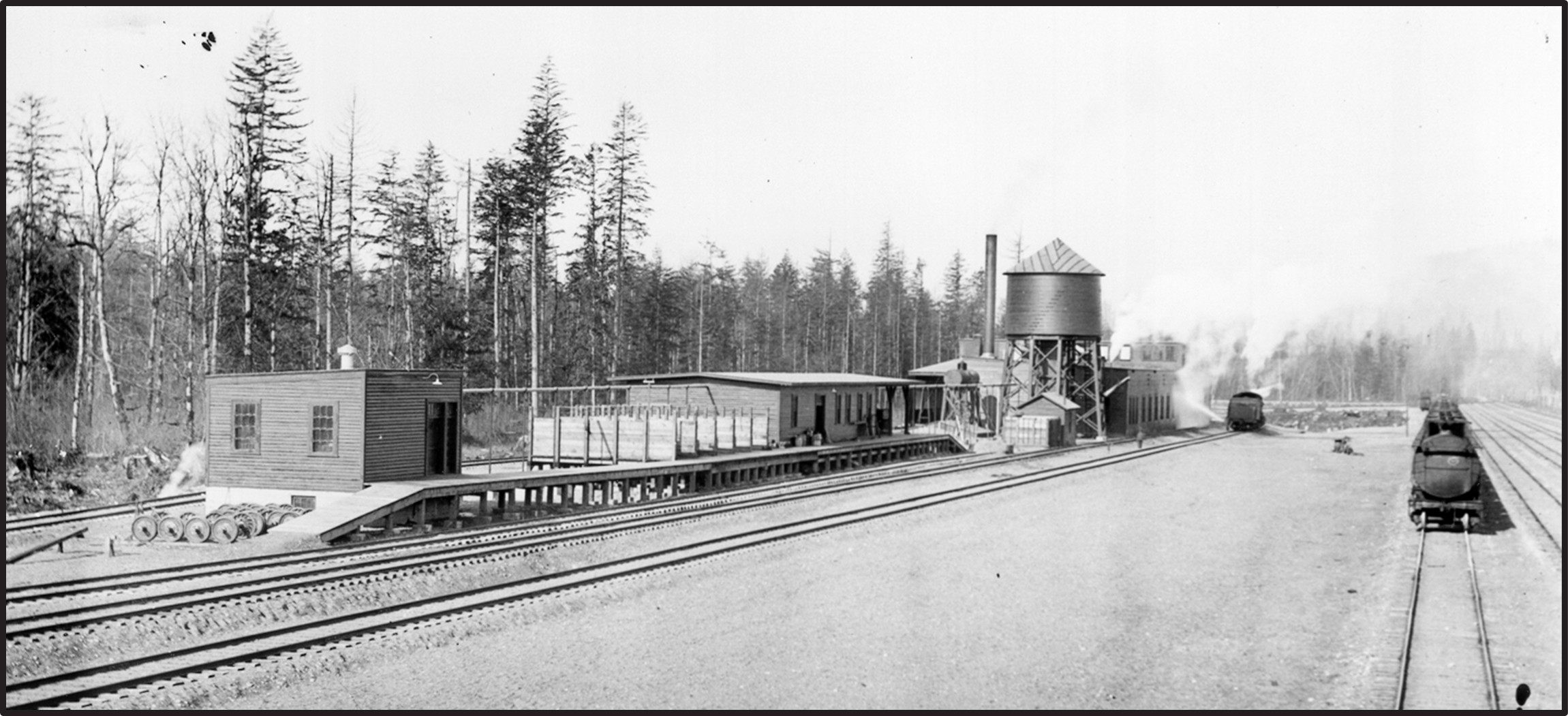
Gold Bar Great Northern Roundhouse. A Lee Pickett photo, taken about 1920. #0174

Skykomish Roundhouse and water tower on the right. Town can be seen on the left. Train engine is facing west. Photographer is unknown. Taken in early 1920’s. Courtesy of Warren Wing.
For entertainment, Harold would sometimes go to the ten and fifteen cent Star Theater, located two lots from the Skykomish Hotel. In 1926 the railroad workers union called a strike, asking for better hours and benefits. Sixmonths later, Great Northern settled, but all the replacement workers were to be retained and would now have seniority over all the striking union members, no matter how many years they had with the railroad. Many railroaders were so bitter against the railroad that they never returned to work for the Great Northern; Joe Gibson was one of them. Furthermore he admonished his sons to never work for Great Northern, and they never did.
After the strike ended, Joe went to work for Bloedel Donavan, firing logging locomotives in the woods.
Upon Harold’s’ graduation from Skykomish High School, he took up studying Barbering under a local barber named Paul Fournier, who owned and operated the local barber shop. A haircut, then, cost one dollar.
Harold tried his hand at several different jobs. He worked for a while for Bloedel Donavan, and even played banjo for a local band. Harold met Mr. Purdy during the depression, and decided to become a mortician. He went to work for Purdy and Son’s, now Purdy and Kurr, out of Everett, Washington.
In 1938, Harold met Oleda Evelyn Christopherson, fell passionately in love and married her December 12, of the same year.
Harold quit working for Purdy and Son’s, and went back to work for Bloedel Donavan. Having a keen interest in electrical work Harold eventually went into business for himself as an electrician.
Leda, Harold’s wife, opened up her own ceramics shop out of their home in Skykomish. Harold is quite proud of his wife’s accomplishments. When Harold speaks of her it is with intense devotion and reverence of a lifelong companion.
Harold and Leda never had children, but they have a town full of friends. Harold will be 90 in November; a legend in Skykomish.
(This story first appeared in Volume Five of the Highway 2 series, in August 1999. Harold has since passed away.)
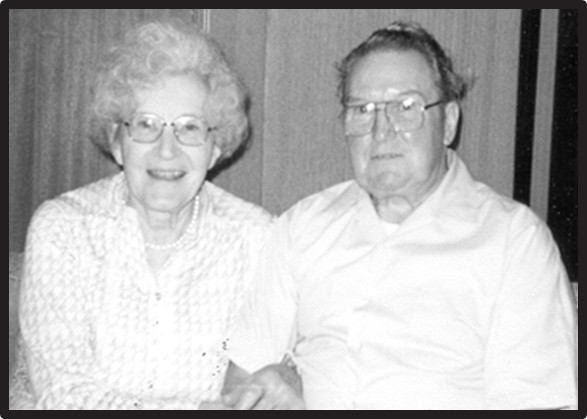
Harold and Leda Gibson, New Year’s Eve, 1982
Earl Gibson
(A Biography)
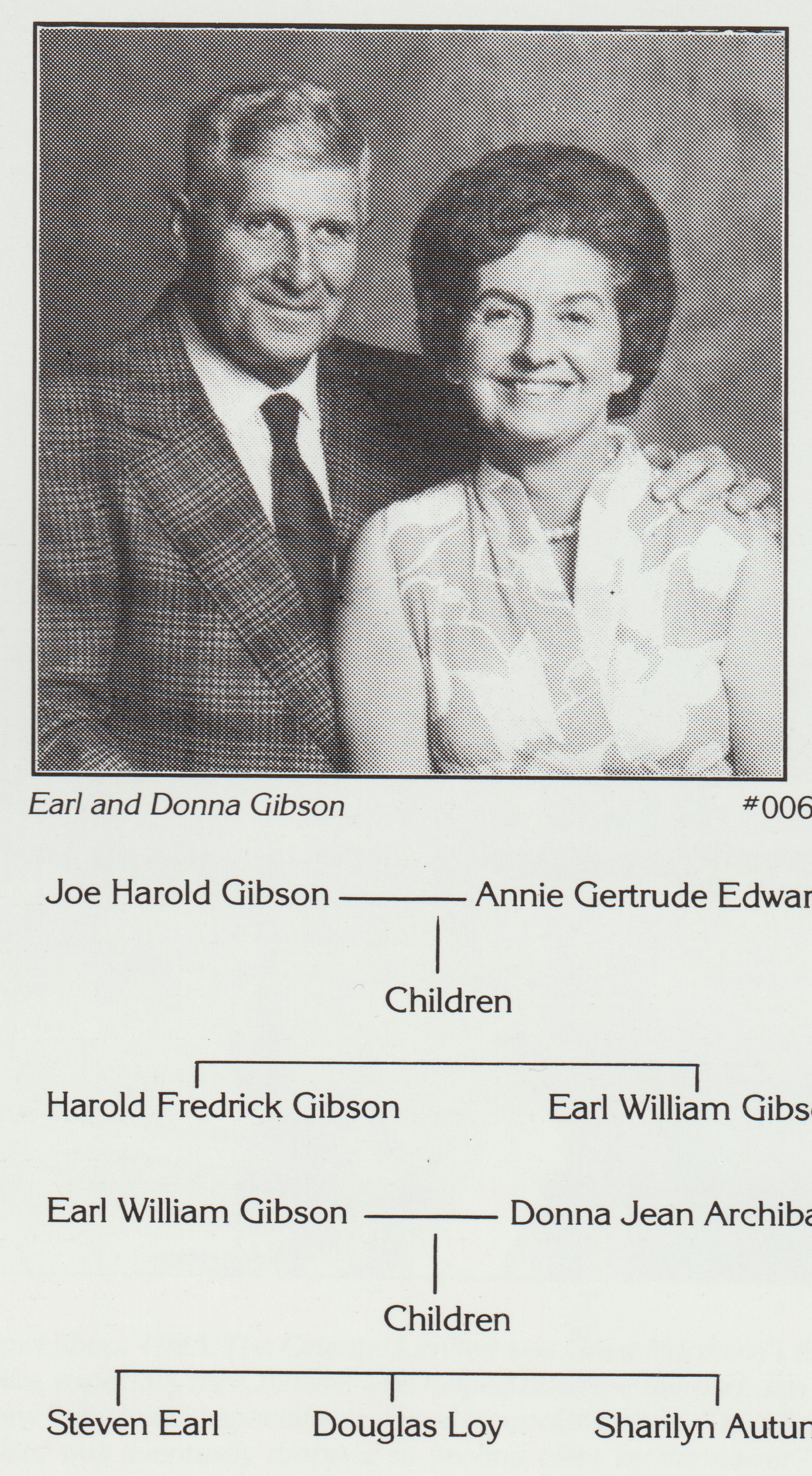
Earl W. Gibson, born in Gold Bar, raised in Skykomish and currently of Monroe, Washington, is truly a Skykomish Valley resident. Earl’s father, Joseph Harold Gibson, (Joe), was born in 1884 at Halifax, Nova Scotia, Canada.
His mother, Annie Gertrude Gibson, maiden name Edmonds, was born in Halifax, Nova Scotia in the year of our Lord 1887.
Like many industries in Canada the railroad was controlled by the government. Your job depended upon elected politicians. In many cases you were required to collect names from graveyards in order to pad the balloting for a particular politician who would in turn, if elected, ensure your employment.
Joe had been employed by “Inter. Colonial Railroad” in Nova Scotia, but by 1911, having possibly fallen on the side of the wrong politicians, he was in need of a job. Joe, along with his wife and two-year-old son, Harold Frederick Gibson, born February 17, 1909, moved to Everett, Washington. There Joe began working for Great Northern Railroad at the Delta Round House as an engine inspector.
The railroad industry was still young, and the powerful engines were constantly evolving in order to become more efficient. The climb over Stevens Pass, with its numerous switchbacks and steep grades presented weight problems.
Through experimentation it was discovered that oil burned hotter and cleaner than coal, requiring less maintenance to the engines. Also, less oil was needed to go the same distance as coal, reducing the weight.
In 1912 Great Northern began converting the engines going over Stevens Pass from coal to oil. Fully familiar with the process, Joe was sent by the railroad to the Skykomish Round House as an Engine Inspector and to train the engine fireman how to fire with oil.
Joe began construction of a house in Gold Bar, meanwhile renting a house for his family until the new house was completed in the same year. He spent much of his time apart from his family living in the “work trains” in Skykomish. These trains were supplied by the railroad and consisted of several box cars specifically designed for various functions, some for cooking and dining, others for sleeping.
The commute from Skykomish to Gold Bar was done by rail via the “Gold Bar Helper”. These were trains designed purposely for the heavy haul over the pass.
On July 17, 1914, Earl William Gibson was born at the home of his parents in Gold Bar.
For two more years Joe continued to work in Skykomish, living in the work trains and commuting home whenever he could.
In an attempt to get more mileage out of the heavy locomotives making the steep climb over Stevens Pass in 1915-16, the Great Northern transferred the Skykomish Round House to Gold Bar.
Once the move was completed, Joe’s duties at the Gold Bar Round House were broadened to Include Night Round House Foreman as well as Engine Inspector.
The move of the Round House to Gold Bar proved to be short lived. In 1922 the Round House was moved back to Skykomish. The Great Northern had bigger and more powerful locomotives and it was believed by some that Skykomish was the more logical point of switching the cars to those engines for transfer over the pass.
When Joe was transferred to Skykomish for the second time, he chose to pack up the family and move to Skykomish permanently. By then Earl had completed first and second grades at Gold Bar Elementary.
In 1925, while in the 5th grade, and at the age of eleven years, Earl obtained his first job, newspaper delivery.
Earl and his brother Harold had a newspaper route delivering the “Seattle Star”. The paper was published six days a week. It was delivered by way of the “Dinky”, the Great Northern passenger train that made a daily run from Everett to Skykomish, every day except Sunday.
The Seattle Star had exclusive rights to the Dinky run. Although there were other papers, like the Everett Harold, Great Northern and the Seattle Star had an agreement that the Dinky would only deliver the Star. Getting a daily paper to Skykomish any other way besides the Dinky was impossible at that time. The road to Skykomish was little better than a very bad trail.
Customers paid “four bits” a month for the Seattle Star. According to Earl the route was pretty good size and he estimates that he and his brother cleared about ten to fifteen dollars a month between the two of them. “Pretty good wages in those days”. Delivery was slow in the winter at times because of the deep snow, but in the summer they each had bicycles which made quick work of the route.
The Seattle Star went out of business around 1928 or 1929 and that was the end of their paper route.
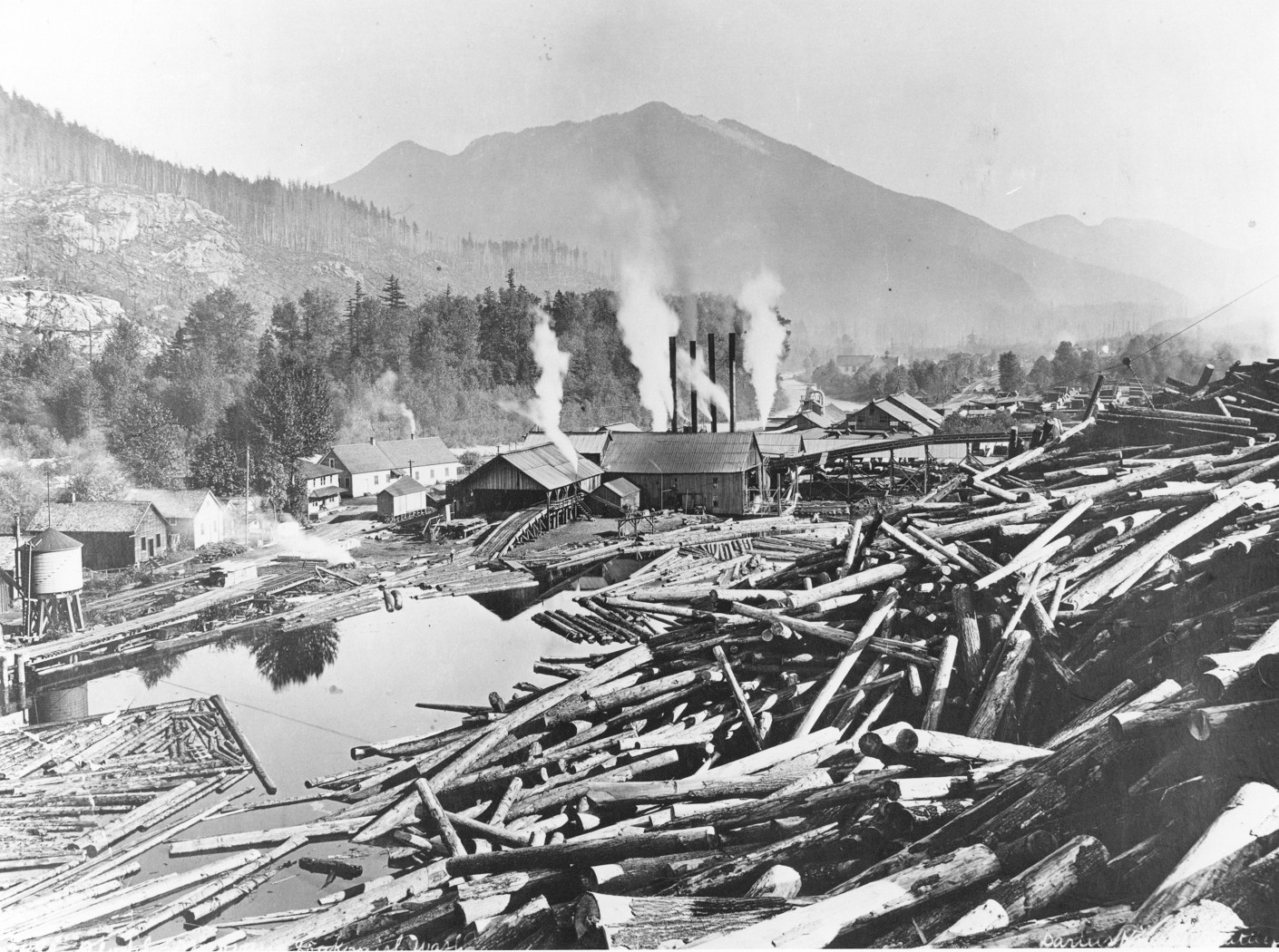
Joe Gibson retired from the railroad in 1926 and went to work for Bloedel Donavan firing logging locomotives in the woods. The Great Depression shut down the mill in 1931. In 1933 the shingle mill was back in operation followed by the big mill in 1935. Joe retired from Bloedel Donavan in 1950 when it was sold.
Earl graduated from Skykomish High in 1932, the same year the Great Depression hit Skykomish. During the summers of 1933, 1934 and 1935 Earl worked for Northwest Portland Cement located in Grotto. He ran the little Lokey, (locomotive), that was used to haul rock from the shovel to the crusher. When he was not running the Lokey he was company handyman. Snow closed the company down in the winter.
Earl claims that jobs and money were rare commodities in Skykomish during that time, but the community pulled together and helped each other out. Bartering was the common tender of the day. No one hoarded what they could not use and someone else needed. The Bloedel Donavan Lumber Yard was stocked with lumber they could not sell. If you needed it, you were pretty much welcome to it. Berry farms were common in the valley, but what the owners could not sell, they gave away.
Skykomish finally came out of the depression between 1935 and 1936. Earl went to work for Bloedel Donavan in 1936. The mill sold to an eastern outfit in1945 and named the “Empire Mill Work”. Earl continued working for them until 1950 when the mill closed for good.
However, in 1940 the mill hired a new logging superintendent named Orin Lonis Archibald. Orin came with his wife and two daughters from Port Angeles.

Earl was one of the construction workers for Bloedel Donavan at the time the mill hired Orin and built a house for the Archibald family. It was during the construction of the house that Earl met sixteen-year-old Donna Jean Archibald for the first time. Earl was twenty-six years old. Three years later Donna graduated from Skykomish High School. On July 1, 1946, three years later, Earl and Donna were married. It was a private ceremony in Seattle, performed by a personal friend of Earl’s, the current Chief Justice of the Supreme Court of Washington, Mathew W. Hill.
After the mill closed in 1950 Earl went into construction. One project that Earl is particularly proud of being a part of was the construction of the Money Creek Bridge, built in 1957 and still in use.
In 1963 Donna Gibson became a postal clerk for the Skykomish post office located in a small section of John Maloney’s Merchandise store. She became “Officer-in Charge” in 1976. In 1978 she was transferred to the Bering Post Office where she was “Officer-in-Charge” until 1980 when she was appointed Postmaster of the Bering Post Office, a position she held until her retirement in 1985.
Together Earl and Donna had three children: Steven, Douglas, and Sharilyn. All were raised in Skykomish, and like their parents, all graduated from Skykomish High School.
After retirement, in 1985, the Gibson’s moved to their present home in Monroe. With three grown children, eight grandchildren, and one great grandchild, the Gibson’s are true pioneers and residents of the Sky Valley.

 Sky Valley Messenger