Ten Days in a Snowshed
By Fred S. Wightman
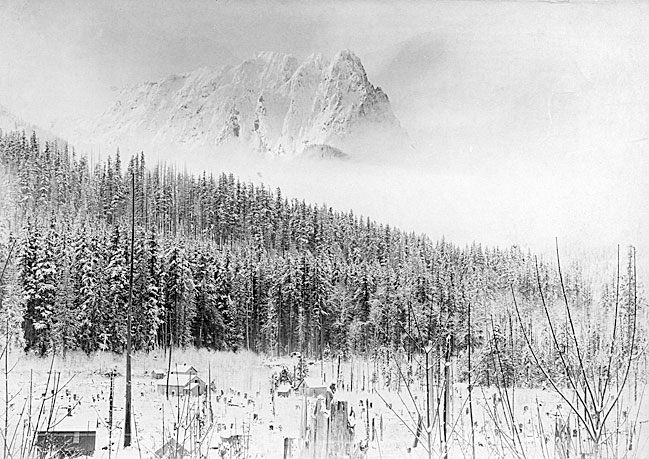
The top photo is of a snowy Index, Washington, with Mt. Index in the background.
The following story was first published about 1940 in “Railroad Magazine”, under the heading “True Tales of the Rails-Actual Happenings Told by Eye Witnesses”. I suspect that the story was published much earlier due to the fact that there are many similarities to the Wellington disaster which happened only three years later, yet was not mentioned in this story, published 40 years later. Because of the similarities I believe that all will find this story both historically relevant and entertaining.
The photos in this republication are not original to the story and are not accurate to the story and are only included to help the reader gain some perspective to the real event.
It has been many years since I read “The Outcasts of Poker Flat,” a Bret Harte fiction story of the old west, so I cannot tell you how long that little party of outcasts was marooned by a blizzard in a desolate cave about midway between Poker Flat and some other mining settlement. But I can tell you about the ten days and eleven nights that I was snowbound with the crew and passengers aboard a Great Northern train in a snowshed of the Cascade Mountains a mile and a half from Wellington, Washington, back in 1907, the year that Jim Hill resigned as president of the Big G.
I would not go so far as to claim that no other train, before or since, has ever been snowed in for so long a period. All I can say is that I do not know of any such. If the record has been beaten, I would be grateful to any reader who tells me about it. So far as I am aware, the record stands.
Back in those days I was a railway postal clerk–and had been since early in 1904—in charge of the United States mails between Spokane and Seattle, approximately 345 miles; and the incidents I am about to relate occurred on one of the runs between those two cities.
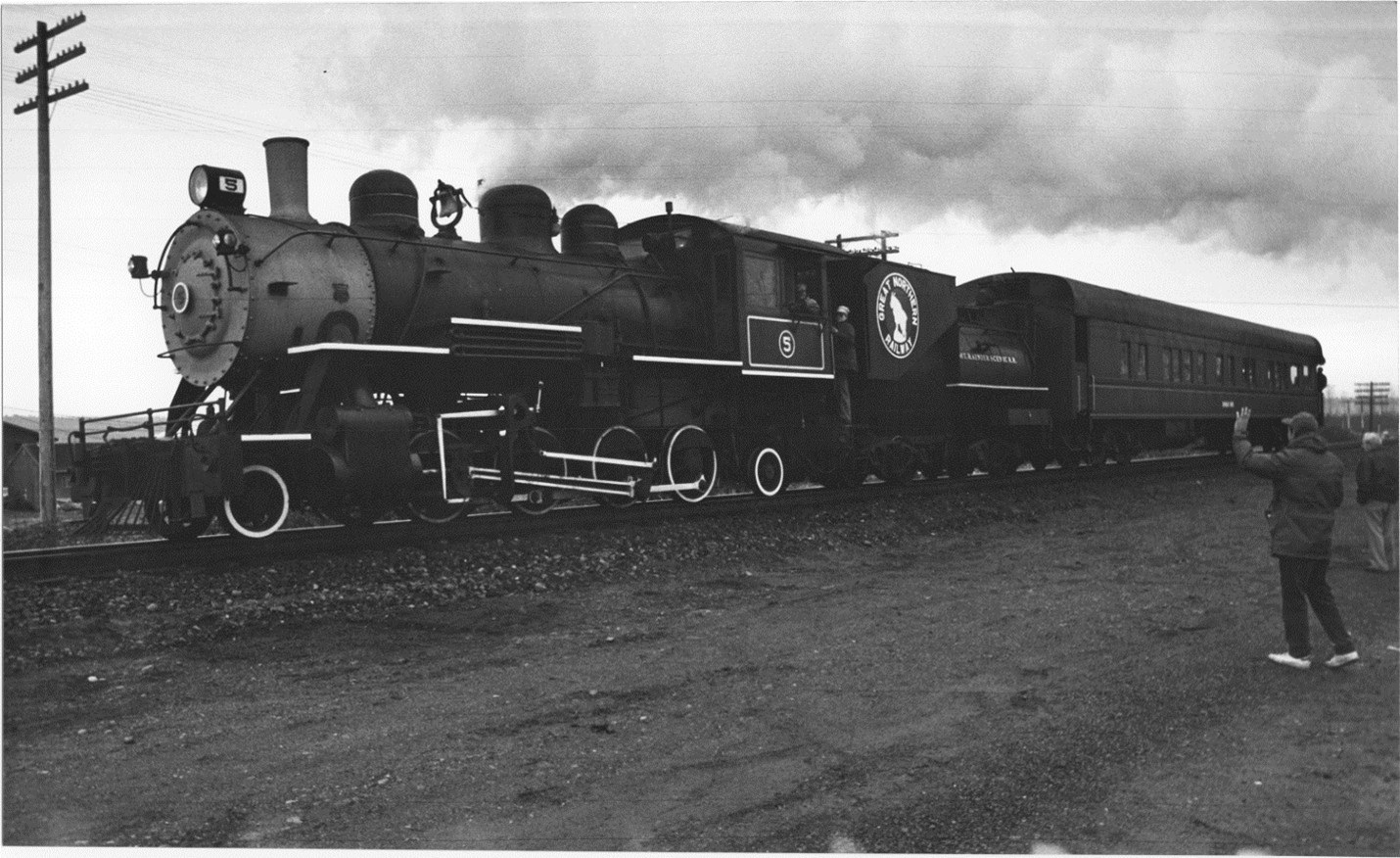
The above photo was taken in Monroe, Washington in the 1980’s by Buddie Williams. It is the Great Northern #5, possibly much like the #4, the Engine trapped in the snowshed.
With train Number 4, in charge of Conductor Copeland and Engineer Duffy, we left Seattle on a raw gray December morning. Snow had been falling heavily in the lowlands, blanketing everything with white, and the storm increased in fury as we climbed the higher altitudes. On our arrival at Skykomish, the division point where helper engines were coupled onto the trains to assist them over the mountain grade, we learned from the station agent that further on the snow was swirling down at the rate of a foot an hour.
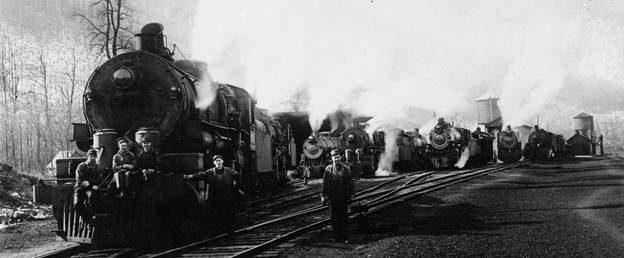
Above is a Lee Pickett photo of the helper engines lined up, fired up and waiting for the eastbound trains needing help going over the Cascade mountains. The train featured in the story would have stopped here and hooked up an extra engine here.
This news called for a conference between our train crew and the operating officials, as the result of which a double-ended snowplow was sent out a little distance in advance of us, to keep the track clear if possible. This equipment, in case you are not familiar with it, consists of one rotary plow in front, two engines in the middle, and another rotary bringing up the rear, all coupled together, the double-ended effect being necessary to permit a return movement over the same track without the use of a turntable or wye.
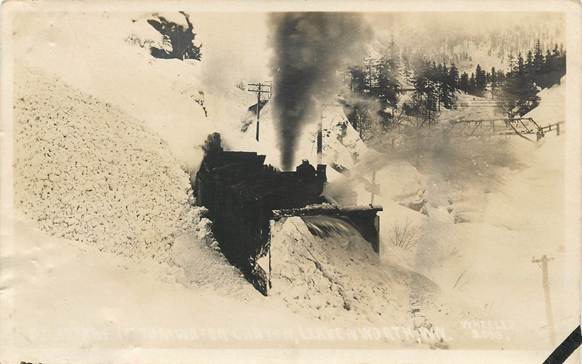
The photo on the bottom of the previous page is of a Great Northern rotary plow working in the Tumwater Canyon on the east side of the cascades, near Leavenworth, Washington. This rotary is the same as that used to free the #4 in the story.
The double-ender left Skykomish about fifteen minutes ahead of us. Our train was pulled by a fast passenger engine of the 1400 class and an 1100 freight locomotive used as a helper. In addition to the railway mail car, which I rode, we had a baggage-car, a smoker, a day couch, a tourist sleeper, a dining-car, a standard sleeper, and an observation car with sleeping compartments in its forward end.
As we climbed the grade from Skykomish, the blizzard became so fierce that fresh snow quickly filled the cut which our double-ended plow had made, and before we had traveled twelve miles out from the division point, we were stalled in a mountainous drift. There we stuck for two hours, until the plow returned from Scenic Hot Springs and got us moving again. We were four hours late when we fought our way into Scenic Hot Springs, with the aid of the four locomotives; and there, over the one remaining wire, the crew argued with the dispatcher as to whether we should return to Seattle or continue the attempt to break through to Spokane. The DS was adamant; Number 4 must go on.
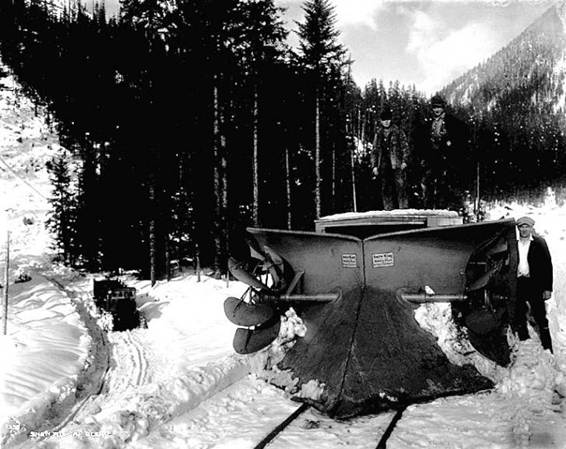
The above photo is of a later version rotary engine, (1927) being used to clear the tracks near Scenic, Washington.
And so, preceded by the snowplow as before, we pulled out of Scenic Hot Springs late that afternoon in the direction of Wellington and the western summit of the Cascades. Our immediate objective was only about three miles away as the crow flies, but the circuitous rail route was nearly seven times that distance and was approximately 1100 feet higher than Scenic Hot Springs. Adding to our difficulties, a rising temperature had now turned the snow into rain—which, as any mountain man will tell you, increases the hazards of train operation.
Nevertheless, we continued up the high line and through the reverse tunnel there. Our double heading engines encountered numerous small slides from time to time but succeeded in pushing them aside. The old mountain runners on the Big G had become quite adept at this sort of warfare and luckily, they found no huge rocks nor logs buried in the slides. On the upper stretch the high line was partly covered with strongly timbered snowsheds, and as we ran cautiously through them, one after another, everything went well—until we emerged from a certain shed not far from Wellington.
There we discovered, to our dismay, that an enormous snowslide had suddenly blocked the entrance of the next shed to the east, thus separating us from our plow. For safety’s sake, our engineers warily backed into the shed we had just left. No sooner had they done so than another white hurricane thundered down the mountain, completely covering the exit through which we had just backed; and before we could make another move a third slide stopped up the western end of our snowshed! This isolated us from the rest of the world—for ten days and eleven nights.
During that long period, not a wheel of the train revolved. The snow at this point had been approximately twenty feet deep on the level, before the warm settling rains began. This rain had loosened the huge white blanket, and almost the entire mountain side was now one vast slide ranging from twenty to seventy-five feet in depth, bristling with great logs and boulders.
Our first urgent problem, since we were safe, was to provide an adequate water supply for the engines so that heat could be maintained in the train for the comfort of our twenty-five or thirty passengers as well as the crew. Of this number, there were eleven women and two children; the rest were men. Engineer Duffy and his fireman made a trough out of some loose timber they found in the shed and diverted snow water from the mountain side into the tank of their tender. This solved the water problem. Luckily, we had enough coal left to maintain a limited head of steam, by careful economy; so, we managed to keep reasonably warm. The fuel supply would not have lasted us had we been moving up the mountain grade, as about fifteen tons per engine was needed in those days to put an ordinary passenger train over the hill.
In view of the constant danger of recurring slides, Conductor Copeland would not allow any passenger to leave the train. Although we were confined in the snowshed, light and ventilation penetrated between the slats, these slats being spaces about six inches apart. During the days and nights that followed, we heard numerous slides pass over the shed and continue down the mountain side. If you have never seen or heard snowslides, you cannot adequately imagine the feelings of awe that gripped us all as we listened to the low roar and grinding sound of those mighty rushes of snow. Fortunately for us, a snowslides greatest destructiveness comes from its pushing ability rather than from its downward pressure, and as the Great Northern’s sheds were firmly built, slides usually passed over them harmlessly.
None of us knew how long we would be marooned; and during the first five or six days, while the slides, the rain and a treacherous chinook kept up, nobody dared to venture outside. After twenty-four hours had elapsed and the train had not moved, meals were provided from the diner without charge to everyone aboard—which is, I believe, the usual policy on American railroads. This diner was well stocked with typical restaurant food such as fresh vegetables, fruit, steaks, chops, prime roasts, potatoes, eggs, milk, tea, sugar, coffee, butter, and flour—in fact, everything necessary to feed approximately two hundred people over the train run from Seattle to St. Pail. Two meals a day were served to each person, the dining-car conductor arranging all menus to conform with our supplies.
Safety, comfort, and food having been provided for; our next problem was one of entertainment. The library in the observation car, comprising a choice but small selection of books, current magazines, and newspapers, was thrown open to all passengers. In fact, the whole rear end of the car was set aside as a recreation room. The porter of this car kept the men shaved; but no baths could be provided, because there was no way of forcing water into the storage tank used for bath water.
Cards were supplied to those who cared to play, and dances were held in the diner. Tables were folded up against the wall and chairs removed, thus clearing a modest “dance hall” of about ten by forty feet. An elderly rawboned cowman fiddled for the dancers. He was a typical Westerner, wearing a wide-brimmed hat, high leather boots and a vivid plaid shirt.
The tunes that he played were mostly old ones such as “The Arkansas Traveler,” “The Irish Washerwoman,” and the like, together with some favorite waltzes, schottisches, and polkas. We all joined in the fun, passengers, enginemen, trainmen and baggagemen. Only the porters, the waiters, and an aged colored minister sat around and watched the others step the light fantastic. Most of the “wall flowers” devoted their leisure to the “galloping dominoes” and cards, and not a little money changed hands during these pastimes.
On Sunday the sky pilot, dresses in rusty black, conducted devotional services in the diner. He preached a simple sermon and led the singing of familiar hymns— “Jesus, Lover of My Soul,” “Nearer My God to Thee” and “Rock of Ages.” The cowboy fiddler who now supplied church music was obviously embarrassed, but everybody seemed to enter into the spirit of the occasion; and the collection which was taken was presented to the preacher.
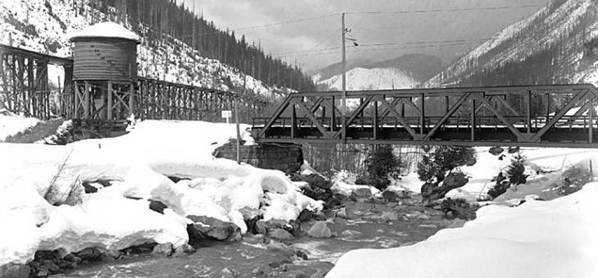
Scenic, Washington as it would have appeared at the time of the story.
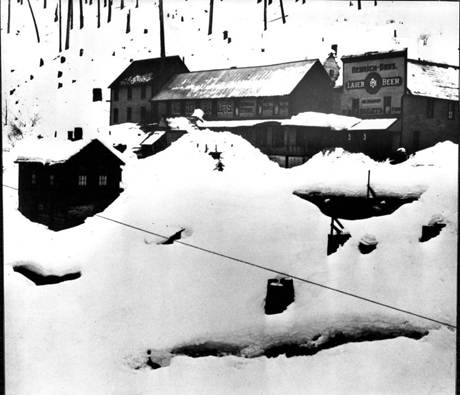
Wellington three years after the time of the story, but the conditions would have been nearly identical.
Meanwhile, as the days passed our food supply kept dwindling. We had been imprisoned for nearly a week. The weather was now clear and much colder and the danger from snowslides had diminished, so members of the train crew and I volunteered to make the mile-and-a-half trek to Wellington to buy some additional grub. This we did, climbing gingerly over the slides, with our hearts in our mouths. With a pick we chipped away the iced snow at points where the footing was insecure, and eventually reached the little village of about fifty inhabitants. Everybody in town was an employee of the Great Northern Railroad, except for the Bailetts and his wife, who ran the general store. There was no way out of Wellington but by rail or trail—and very few persons had used the latter since the railroad was built. The villagers, snowbound like ourselves, were amazed to see us arrive afoot. They’d had no idea that our train was tied up so close to them but thought it had been forced by the storm to return to Seattle.
We left our pick at the village and bought as much food as we decided we could carry—two hams, fifty pounds of potatoes, a forty-nine-pound sack of flour, and some canned milk. This we divided into packs weighing approximately forty-five pounds per man; and with the burdens securely strapped to our backs, we made our precarious return journey to the stalled train.
With our food supply assured once more, we waited patiently as we could for a rescue party to break through. All the passengers, regardless of whether they had paid only coach fare, were provided with beds in the sleeping-cars as a courtesy of the railroad company. In fact, the company, through its employees, did everything they could to make the men, women, and children comfortable and contented during their enforced stay on the train. Conductor Copeland and his brakemen made regular rounds among the passengers, assuring them that all would be well. This had a soothing effect upon those inclined to be nervous.
Also, the trainmen made frequent inspection of handbrakes, to see that they had not slipped. These breaks had been set when the train was first stalled, to prevent any movement of the train. In addition to this precaution, the trainmen kept the car wheels blocked by hard chunks of wood, as our train stood on a grade of 1.6 per cent and any snowslide or shock might have started it on a downhill movement. Meanwhile, the engine crews maintained a light fire in the firebox of one locomotive, as I said, barely enough to keep up steam for heating the cars.
Members of the crews, having little work to do, mingled freely with the passengers, and helped them to while away the long hours by reciting tales of railroad adventures. Some of these tales I have reason to believe were true. Being in charge of the United States mails, I kept the mail car locked and I slept in it every night, but during the daytime I was at liberty to enter into recreational activities.
Another car from which all passengers were excluded was the baggage car, in which our telegraph set was located. In those days, all long-distance passenger trains on the Big G were equipped with telegraph instruments, which the rear brakeman was supposed to be able to operate. This was a company rule, so that officials could get first-hand information whenever a train might be delayed and not in touch with a station operator. As the telegraph wires were in the snowsheds and underground between the sheds, it was necessary to repair only that part of the line, further down the mountain, which had given way under the heavy snow.
On the ninth day of our confinement the telegraph sounder began to show signs of life. The brakeman-operator tapped out a message describing our location and stating that all hands were in good health. The reply came back that rescuers would reach us in about twenty-four hours.
At length, on the morning of the eleventh day, members of a rescue crew wearing snowshoes reached us from the outside world. Some of these men came from the double-ended snowplow which the slides had separated from us. The women passengers wept and laughed hysterically when help arrived; but the chief emotion of the snowbound men was, I think, a sense of relief from boredom.
We escorted our twenty-five or thirty passengers to the village of Wellington, which stands at the west portal of the old Cascade Tunnel, two and three-quarters miles long: and then through that tunnel to the Cascade Tunnel station, the highest point on the Great Northern Railroad.
There we found a westbound passenger train unable to proceed or return on account of the thaw and freeze that had tied up traffic. Water during the thaw had run along the depressions in the snow near the rails and, freezing over, had glazed the steel with a thick coating of ice almost as hard as flint. When the crew attempted to proceed, the engine and cars were derailed; and these rails had to be cleared painfully and laboriously with picks for a distance of twelve miles—an occurrence which, I believe, was unique to railroad history.
After that, however, we encountered no further trouble, and we finally arrived at Spokane ten and a half days late. We presented our bills for the food we had bought in Wellington, and the railroad company paid without quibbling.

 Sky Valley Messenger